





Eye For Film >> Movies >> Wicked: For Good (2025) Film Review


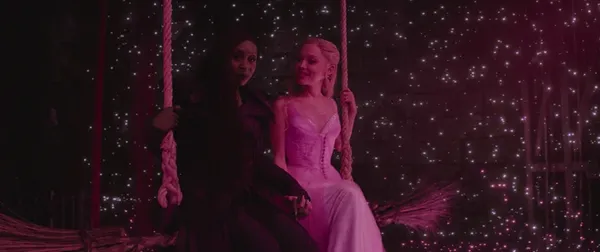

At the end of Wicked Elphaba defied gravity, admittedly haltingly, and soared off, singing, to become The Wicked Witch of the West. That role was one forced upon her by the propaganda of the chartreuse citadel, the malachite metropolis. The Emerald City's mean streets become even less so when the mint-dwelling mob are frothed to frenzy.
"All roads lead to Oz," but the film doesn't always trust audiences to remember where we've been. The yellow brick road we'll follow is a product of paint and pattern, and so is the film. Not really a sequel, more the last act of a prequel, the film has a difficult course to tread. It's the second half of a film adaptation of a stage adaptation of a book that's inspired by another work better known for its own film adaptation. That path is readily highlighted though, from the off.
You'd be forgiven for wondering how a meditation on morality is changed to make shades of grey into a struggle between pink and green. There's scarcely time, however, as Wicked: For Good smothers many of its subtleties under a blanket. Those yellow bricks are laid out with metronomic precision until Elphaba swoops back to disrupt. The film has a similar depth of detail, festooned with furnishings and clothed in quality costume that obscures structural issues.
That Jon M Chu and Dana Fox were willing to break Defying Gravity into pieces was signal that no element of the musical was safe. As with other nested adaptations a willingness to make changes can often be a strength. If nothing else, elements of the ending will be a surprise to some. Unfortunately while this is undoubtedly Wicked: For Good it is not necessarily Wicked for the better.
There are new songs, unsurprisingly perhaps as there's a further two hours to fill. Each part of Wicked rivals the stage show in length. Together they'd bridge the gap between matinee and second sitting. That in part is why it's effectively impossible to regard this as a thing itself. Wicked: For Good won't stand alone. Its relationship with the first part is as codependent as that between its main characters. Each of them gets a new original song.
No Place Like Home is perhaps the weaker, but its obvious homage to the 1939 film feels most likely to spark awards recognition. Cynthia Erivo's talent is not hidden by the makeup and effects that make her Elphaba, but her song feels slighter despite its interactions with the roots of Oz. The Girl In The Bubble is both more muted and more in keeping with character development. Ariana Grande's turn as G(a)linda has revealed her quality as an actress, and singing from her bubble, literal and metaphorical, gives her a real chance to shine.
Stephen Schwartz penned both those songs. Their function is in part to pad the picture. John Powell's work on the other parts of the score won't have been made easier by the quantity of other musical work to draw from. What on stage might have been a brief bit of business with a swift sting from the strings must here be more substantial, and making the incidental fit as well is not accidental.
Similarly skillful the work of the art departments, including production and costume design. Alice Brooks' camera has acres of detail to capture; literally so with the tulip fields of Munchkinland. On the big screen and in larger formats there's loads to look at. Every thread and thorn seems note perfect. For all that practical work there's also a lot of digital effects.
For the animals of Oz, one might be forgiven for thinking it wasn't that far short of a zoo. Species like shoebills and koalas and squirrels (that fly) are exotic enough to hide computer graphic shortfalls that may be more noticeable with lions or tigers or bears (oh my). They are astonishing in their quality. There are plenty of places where the only indication that they are not present but pixels is that no amount of prodding or peanut butter could induce that behaviour.
Less solid is a bit of digital de-ageing in a flashback that isn't so much expository as patronising. Industrial Light & Magic are at the forefront of these techniques. They couldn't quite pull it off with a face as frequently filmed as Harrison Ford's for The Dial Of Destiny; the benefit of a couple more years of graphics cards hasn't helped bridge what feels a much larger gap. A reprise, a repeat, a retread, and potentially regret.
Across a large cast there are some oddities. It's nice to know Colman Domingo voiced The Cowardly Lion but if one wasn't told I'm not sure how one would tell. Bethany Weaver appears as Dorothy but she's kept as silhouette, an impression of pig-tails and a blue gingham dress for much of her short time on screen. This isn't her story. We already know most of it. Jeff Goldblum's Wizard owes a different debt to Michelle Yeoh's Madame Morrible, and the changes in their dynamic are more of how the film differs from its sources. While its central pair are incredible vocalists there are others whose struggles must be charitably read as character notes.
This may seem like splitting hairs, but part of the frustration with Wicked: For Good is that, as with its other half, its quality in so many places highlights its weaknesses in others. Notes that don't quite match are discordant, and so too in the film. The changes it makes to the story in places undercut some of its songs, and while there's an argument about which serves what in a musical the contrast troubles in either direction. Its two stars are striking, Grande(-Butera) and Erivo give multi-layered performances that are compelling in their power. Chu's choice to allow them to sing on set and then use of re- or pre-recorded versions of these numbers is absolutely the best of both worlds.
There are several set-pieces that leverage the advantages of cinema over stage. Beyond the magical menagerie there are flights of fancy no theatre's roof could compass. A camera can circle singers in ways that even seating in the round cannot achieve, and while not quite a split screen, duets at a distance are here deftly done. The use of reflection during The Girl In The Bubble would be a tour de force even if its thematic weight wasn't as significant. It's almost certainly this film's greatest bit of innovation, and for fans of Wicked in its other iterations it's that which most commends it.
That mention of fans of Wicked is where the other issues lie. As with Dune, another film of complex adaptation, there are those who follow the book, the picture, and those who take a less consistent path. It is undoubtedly easier to access Wicked on screen than on stage, but convenience and cost are potentially outstripped by a combined running time of just shy of five hours. That said, the film's willingness to break apart its songs might strike a chord with audiences who may correspondingly feel no guilt in breaking up their viewing.
Reviewed on: 25 Nov 2025


Director: Jon M Chu
Writer: Stephen Schwartz, Winnie Holzman, Gregory Maguire
Starring: Cynthia Erivo, Ariana Grande, Jeff Goldblum, Michelle Yeoh, Jonathan Bailey, Ethan Slater, Marissa Bode, Colman Domingo, Bowen Yang
Year: 2025
Runtime: 137 minutes
Country: US, Canada, Australia
Festivals:
Search database:
